Hyrox has become one of the fastest-growing fitness races in the world, and for good reason: anyone can enter, the format never changes, and you can train for it in any gym. But it is also a race that punishes people who prepare the wrong way. Strong athletes blow up on the runs. Good runners fall apart on the sled. This guide covers everything I go through with athletes preparing for their first race.
Key takeaways
- Hyrox is 8 × 1 km runs, each followed by one of 8 fixed workout stations.
- Running makes up more than half of most athletes’ finishing time, so train it like a running race.
- Train four things: easy running, race-pace intervals, strength, and running on tired legs.
- Give yourself about 12 weeks if you already train regularly, and start your race slower than you think.
What is Hyrox?
Hyrox is a fitness race made of 8 × 1 km runs, each followed by one functional workout station. You run 1 km, complete a station, run 1 km, complete the next station, and so on until the final wall balls. The order and the distances are the same at every event worldwide, which is what makes it so trainable.
Between the running track and each station is the Roxzone, the transition area. Time spent there counts, and it adds up more than most first-timers expect.
The 8 stations
Weights by division
Most first-timers race in the Open division, or in Doubles (two athletes share the station work but both run every kilometre). Approximate Open and Pro standards:
| Station | Women Open | Men Open | Women Pro | Men Pro |
|---|---|---|---|---|
| Sled Push (incl. sled) | 102 kg | 152 kg | 152 kg | 202 kg |
| Sled Pull (incl. sled) | 78 kg | 103 kg | 103 kg | 153 kg |
| Farmers Carry | 2 × 16 kg | 2 × 24 kg | 2 × 24 kg | 2 × 32 kg |
| Sandbag Lunges | 10 kg | 20 kg | 20 kg | 30 kg |
| Wall Balls | 4 kg | 6 kg | 6 kg | 9 kg |
Standards can change between seasons, so always check the official rulebook for your event before you build your training around these numbers.
It is a running race first
This is the single most important thing to understand. You run 8 km in total, and for most athletes running makes up more than half of the finishing time. Every station is also done on legs that have just run, and you run every kilometre on legs that have just done a station.
That is why CrossFit athletes are often surprised. Lifting strength helps on the sled, but it does not carry you through 8 runs. The biggest improvements for most people come from building their aerobic engine and learning to run well when tired, which is called compromised running.
Coach’s rule of thumb
The 4 things your training needs
- Aerobic running: mostly easy, conversational runs that build your engine without wrecking your legs. This is the foundation.
- Threshold and interval running: repeats such as 1 km efforts at your target race pace, so race pace starts to feel normal.
- Strength: squats, deadlifts, lunges, and pulling. Two sessions per week is enough to keep the sled, carries and lunges from becoming your weak point.
- Compromised training: runs combined with stations, so you practise exactly what race day feels like: running on heavy legs and working on high heart rate.
A 12-week Hyrox training plan
Twelve weeks is a good timeline for a first race if you already train regularly. If you are starting from very little, give yourself 16 to 20 weeks.
Weeks 1–4
Base
Easy running volume, station technique, two full-body strength sessions a week.
Weeks 5–8
Build
Add threshold intervals and weekly compromised sessions. Stations move toward race weight.
Weeks 9–11
Race specific
Longer race simulations at full race weight. Practise pacing and transitions.
Weeks 12
Taper
Cut volume by about half, keep short intensity, arrive fresh.
Sample training week (build phase)
| Day | Session |
|---|---|
| Mon | Strength: back squat, Romanian deadlift, walking lunges, rows |
| Tue | Intervals: 5 × 1 km at goal race pace, 90 sec rest |
| Wed | Rest or easy mobility |
| Thu | Compromised session (see below) |
| Fri | Strength: deadlift, step-ups, sled work, farmers carry, core |
| Sat | Long easy run: 45 to 70 min at a pace you can talk at |
| Sun | Rest |
Sample compromised workout
4 rounds, steady and controlled, not all-out:
- 1 km run at race pace
- 25 m heavy sled push
- 20 wall balls
- Rest 2 minutes
The goal is to hold the same running pace in round 4 as in round 1. If you cannot, the sled or wall balls were too fast, which is exactly the lesson you want to learn in training instead of on race day.
Station tips that save the most time

- SkiErg: drive from the hips, not just the arms. Start controlled; it is the first station and it is easy to go out too hot.
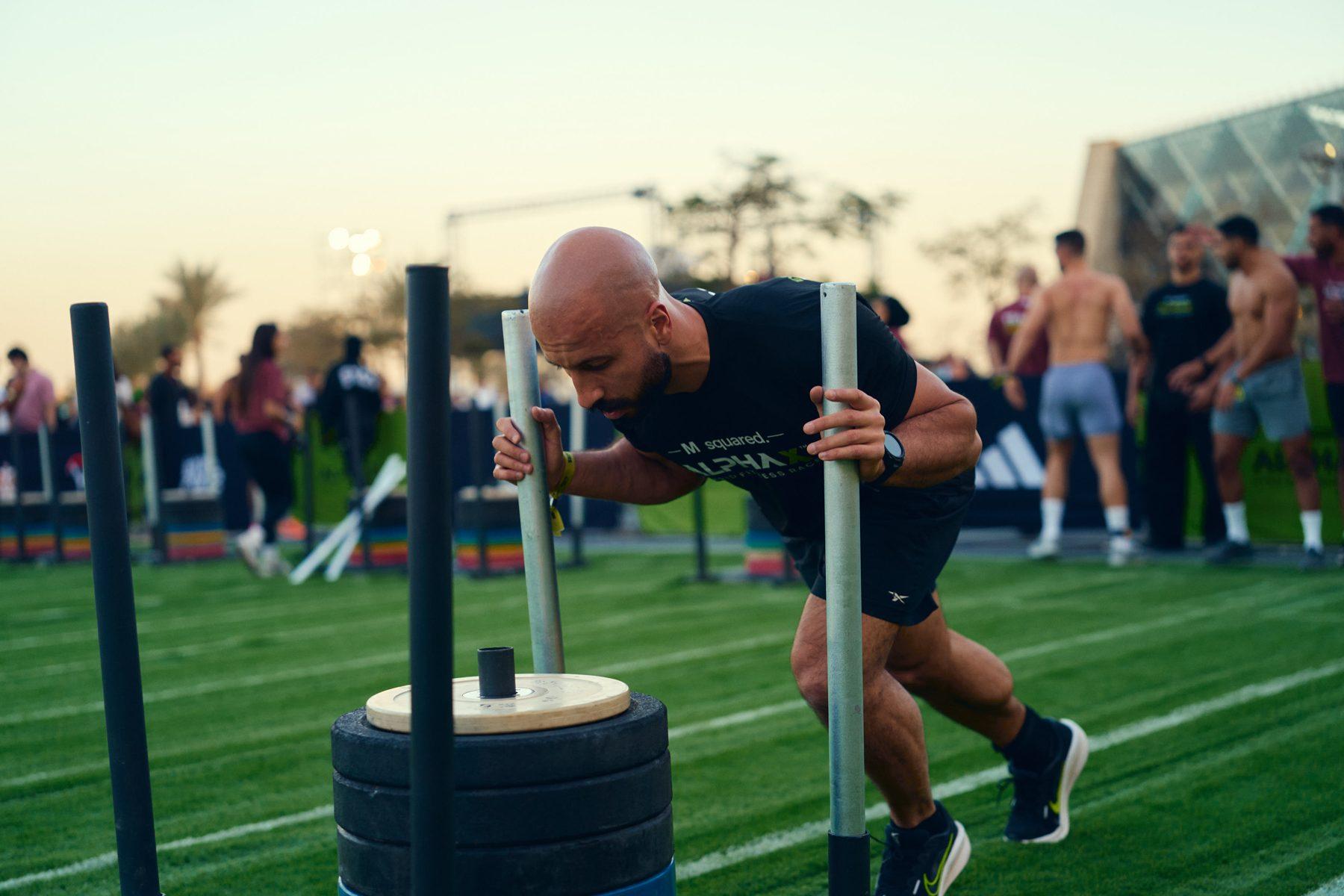
- Sled push: arms bent, body low, short quick steps. Keep moving; restarting a stopped sled costs far more than going slowly.
- Sled pull: sit back into a strong stance and use your legs and hips, hand over hand. Keep the rope tidy so you do not trip on it.
- Burpee broad jumps: a steady rhythm beats big jumps. Step up from the floor if it keeps your heart rate under control.
- Row: legs, then body, then arms. Long, strong strokes at a moderate rate. Use it to control your breathing.
- Farmers carry: fast walk, short steps, tall posture. Put the handles down only if you must, and pick them up immediately.
- Sandbag lunges: find a pace you can hold without stopping. Small, consistent steps.
- Wall balls: plan your sets before you start (for example 25-25-20-15-15) and take short, planned breaks before you fail.
Pacing your first race
The most common first-race mistake is running the first 2 km far too fast because of the adrenaline and the crowd. Start your first run slower than you think. A good rule: your first and last kilometres should be close in pace. Keep your transitions moving: walk briskly through the Roxzone rather than stopping, and have a sip of water ready at the planned moments, not every lap.
Common mistakes
- Only doing CrossFit-style workouts and neglecting easy running volume.
- Never training at race weight, so the sled feels like a wall on race day.
- No compromised running in training, so legs feel foreign after every station.
- Going out too fast on the first runs and stations.
- Trying new shoes, gloves or fuel on race day. Test everything in training first.
What to wear
You need a shoe that can handle 8 km of running but still gives you grip and stability on the sled and lunges. Many athletes pick a stable, cushioned running shoe with good traction. Gloves can help on the sled pull and farmers carry, but practise with them first. We will cover shoes in detail in an upcoming article.
A watch helps you pace the runs and see your splits. If you are choosing one, read my Garmin vs Whoop vs Apple Watch comparison, written after wearing all three for training and racing.
FAQ
How long does a Hyrox race take?
It depends on fitness and division. Elite athletes finish in around an hour, while many first-time racers take somewhere between about 1 hour 15 minutes and 2 hours. Finishing is the goal for your first race.
Can a beginner do Hyrox?
Yes. That is one of the best things about it. Doubles and relay formats are a great way to start, and the Open division weights are manageable with a few months of consistent training.
How many weeks do I need to prepare?
About 12 weeks if you already train 3 to 4 times per week. 16 to 20 weeks if you are newer to training or running.
Is CrossFit enough to prepare for Hyrox?
CrossFit gives you a great base for the stations, but most CrossFit athletes need more easy running and more compromised running to race well.
Want a Hyrox plan built for you?
A general plan is a good start, but the fastest progress comes from training built around your running level, your strength and your race date. At Train Gritty we build Hyrox race-prep programs for each athlete and deliver them daily in the app. See how it works.
Train Gritty is an independent coaching service and is not affiliated with or endorsed by HYROX.